NotesEdition 17 min read
Evolution Lost Its Monopoly
Every creation story I grew up with had a creator. Then we became one. What Echoes of Tomorrow is really about, one year after Synthetic Eden.
Every creation story I grew up with had a creator.
God shaped Adam from dust. Prometheus made people from clay. The Māori had Tāne forming the first woman from earth. Somewhere above us, or before us, something with intention made the thing that eventually became us.
Science replaced the creator with a process.
Mutation. Selection. Time.
For nearly four billion years, that process had a monopoly. Life changed, sometimes radically, but no organism got to sit outside evolution and decide what the next version should look like.
Then we did.
Humans have been interfering with biology for almost as long as we have been human. We bred wolves until some of them could sleep beside our children. We turned wild grasses into wheat and maize. We selected cows for milk, horses for speed, flowers for colors nature had never particularly cared about producing.
But selection is still negotiation.
You choose from the mutations nature gives you.
Genetic engineering changed the verb.
In the early 1970s, scientists learned how to cut DNA from one organism and insert it into another. Almost immediately, some of the people doing the work became worried enough about what they had built that they called their colleagues together.
In February 1975, scientists met at Asilomar on the California coast to discuss the potential hazards of recombinant DNA and establish rules for doing the research safely. The remarkable thing about Asilomar is not that scientists were frightened of genetic engineering.
It is that they already understood what had changed.
Biology was becoming writable.
For most of the next forty years, writing it remained difficult enough that the difficulty itself functioned as a kind of guardrail.
Then CRISPR arrived.
The machinery was extraordinarily powerful because biology had already invented most of it. Bacteria had been cutting genetic material for a very long time. We learned how to aim the scissors.
And in 2018, He Jiankui announced that twin girls had been born from embryos whose genomes he had edited.
The scientific world condemned the experiment. The World Health Organization created an expert committee on human genome editing and later said that proceeding with clinical heritable genome editing at that point would be irresponsible.
But something more important had happened than one reckless experiment.
The hypothetical had become a person.
Actually, two of them.
For decades, philosophers could debate whether humans should alter the inherited genetic code of future generations.
Someone had already done it.
Five years later, the FDA approved Casgevy for sickle cell disease, the first approved treatment in the United States to use CRISPR-based genome editing.
This time we celebrated.
And we should have.
A mutation that causes terrible suffering could now be countered by deliberately changing the biology of a patient’s own cells. The same basic revolution that frightened people when applied to an embryo could save someone’s life when applied to disease.
That is what makes this moment harder than the dystopias usually make it.
The technology is not evil.
It works.
In 2022, DeepMind and EMBL-EBI released predicted structures for more than 200 million proteins, covering nearly every protein then catalogued by science. A problem that generations of structural biologists had attacked molecule by molecule suddenly had an AI-generated atlas.
In March 2024, surgeons at Massachusetts General Hospital transplanted a genetically edited pig kidney into a living human being for the first time.
The organ had not evolved for him.
We changed the animal until its biology became compatible enough with ours to keep a person alive.
Each of these breakthroughs is easy to defend on its own.
Cure sickle cell disease.
Grow organs for people who would otherwise die waiting for one.
Use artificial intelligence to understand proteins and design better medicines.
Prevent inherited disease.
Make crops survive drought.
Engineer microbes to manufacture things without petroleum.
Of course we should.
I work in this world. I believe deeply in what biotechnology can do for humanity. Much of my career has been spent trying to accelerate exactly these kinds of technologies.
That is also why I don’t find the interesting question to be whether we should use them.
We will.
The interesting question is what happens after they work.
Because there is a point at which medicine becomes enhancement.
A point at which adaptation becomes design.
A point at which treating the human condition becomes changing the conditions for being human.
And nobody is going to ring a bell when we cross it.
There will not be one meeting where someone asks whether humanity would like to begin directing its own evolution.
There will be a sick child.
A failing organ.
A pathogen we cannot stop.
A climate humans did not evolve to tolerate.
A planet where our biology no longer fits.
And somebody will have a technology that might save us.
The decision will feel obvious.
That question became Echoes of Tomorrow.
Sean and I did not start with a killer robot or an evil scientist.
We started with a geneticist who is right.
Dr. Samara Makinde is part of a human colony trying to survive on DaVinci, a world that does not care whether the people who landed there are genetically equipped to live on it.
They aren’t.
The planet has its own biology. Its own ecology. Its own rules.
Humanity brought the genome that evolved on Earth.
Those two facts do not reconcile themselves just because people want them to.
Samara sees the problem for what it is.
If humans cannot adapt to the world quickly enough, then the humans need to change.
So she changes them.
Not because she hates humanity.
Because she loves it enough to refuse to watch it disappear.
That distinction matters.
Echoes of Tomorrow is not a four-book warning against genetic engineering, artificial intelligence, or technological progress. I would not have wanted to write that story, because I do not believe it.
Technology is one of the reasons billions of us are here.
The series is interested in a more uncomfortable problem:
What happens when the technology works, but the people using it disagree about what success means?
If you alter a human genome so a child can survive somewhere her parents cannot, have you saved humanity?
Or started something else?
If her children inherit those changes, when does adaptation become speciation?
If an android loves, fears death, sacrifices itself, remembers the people it has lost, and asks to be treated as a person, how much biology does humanity require?
If a human consciousness can be preserved, copied, repaired, extended, or manipulated, where exactly did the person go?
And if someone develops the power to answer those questions for everyone else, what limits should apply when refusing that power might mean extinction?
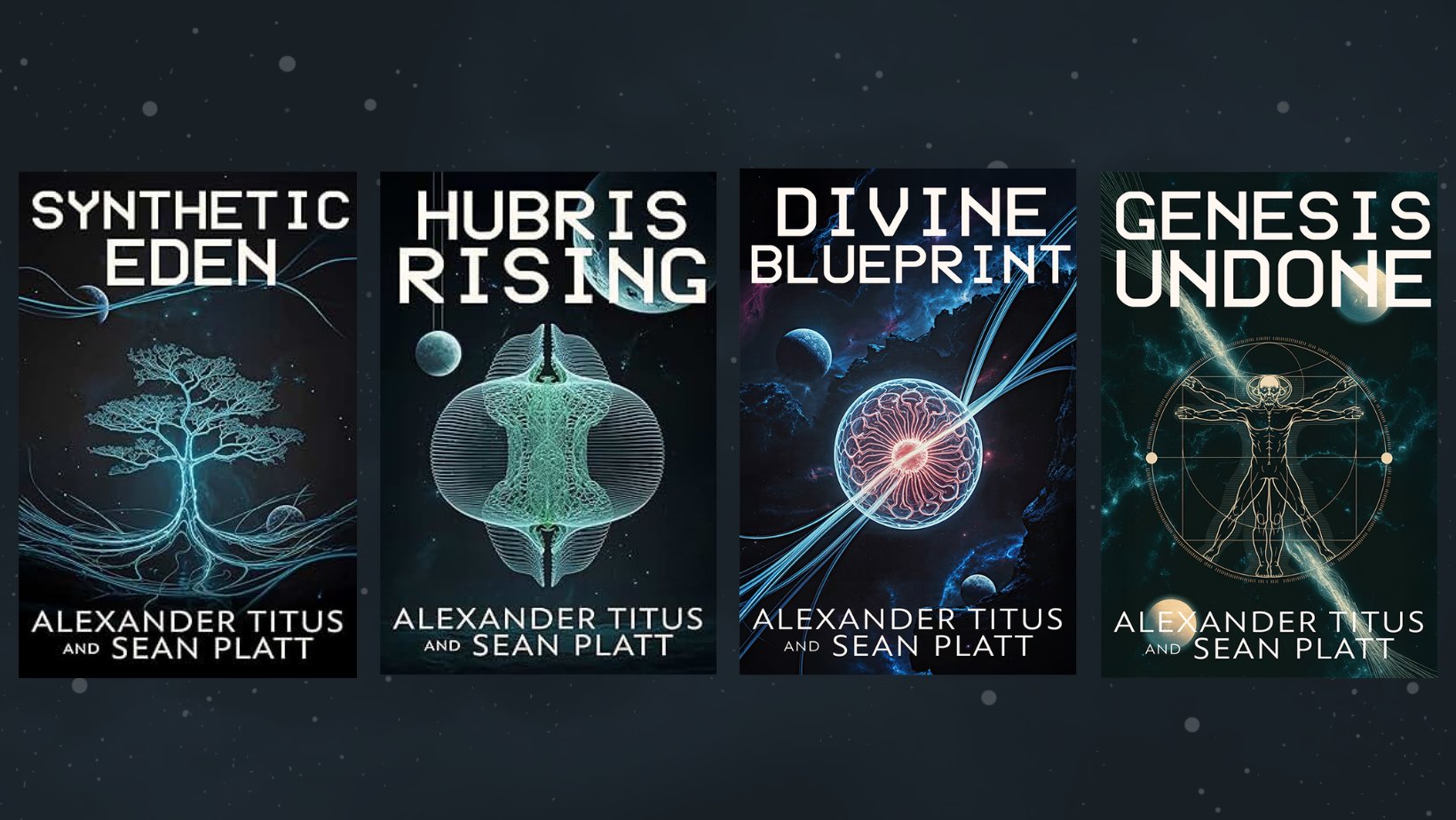
The first book, Synthetic Eden, begins close to the body.
A mother.
A daughter.
A genome.
A choice made because the alternative looks like death.
Then the aperture widens.
Across Hubris Rising, Divine Blueprint, and Genesis Undone, the consequences move outward through families, generations, religions, political systems, artificial minds, engineered ecologies, and competing versions of humanity itself.
The argument stops being about whether one scientist had the right to change one genome.
It becomes an argument over who owns the future of a species.
The Naturalists have an answer.
The geneticists have an answer.
The machines may have one too.
So do the people convinced they can engineer not just healthier humans, but a better civilization.
None of them think they are the villain.
That was important to us.
The technologies likely to change humanity will not arrive wearing black hats.
They will arrive with clinical data.
They will cure diseases.
They will save children.
They will make previously impossible things possible.
And each success will make the next decision easier.
Until eventually somebody looks backward and realizes that the thing being preserved has been changing the entire time.
For most of human history, evolution happened too slowly for an individual person to watch.
That may no longer be the world we are entering.
Artificial intelligence is accelerating our ability to understand biology. Genetic engineering is improving our ability to alter it. Synthetic biology increasingly treats living systems as things that can be designed. Medicine is learning to replace biological functions evolution gave us with ones we chose ourselves.
Each field amplifies the others.
And the loop is getting faster.
That is the future Echoes of Tomorrow exaggerates.
Not by assuming that biotechnology fails.
By assuming it succeeds.
Again.
And again.
And again.
Until survival itself becomes an act of engineering.
By the end of the series, the original question — Should we change human beings? — almost feels quaint.
Human beings have already changed.
The harder question is who gets to decide what comes next.
Evolution had four billion years without us.
Now it has competition.
Echoes of Tomorrow is about what happens when humanity stops merely inheriting the future and learns how to build it.
The future will inherit whatever we choose.