NotesPolicyEdition 86 min read
Government Is the Weak Link
A bipartisan commission spent two years on the biggest threat to American biotechnology and decided it wasn't a lab in China. It was us. On the report I signed, and the future it's built to prevent.
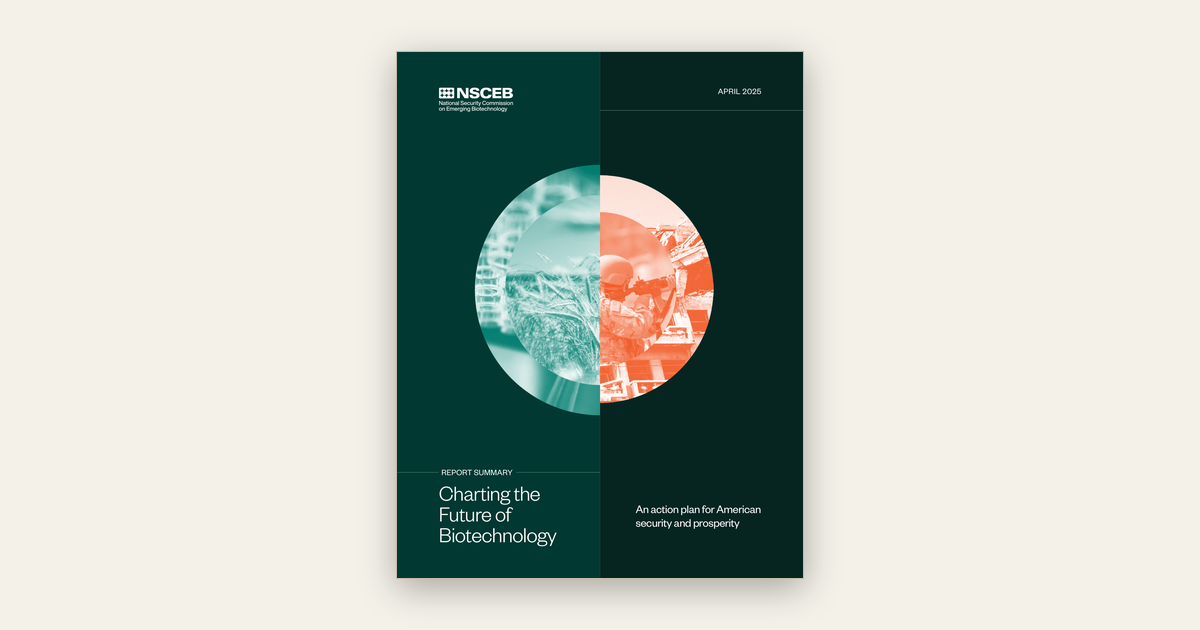
The report I signed opens with a work of fiction.
Picture a lab in Shanghai that develops a drug that clears malignant cells from the body. Cancer, effectively over. Then tensions across the Taiwan Strait reach a breaking point, and the treatment stops crossing the Pacific. It gets held back, in the name of national security. The cure exists. You just can’t have it.
This scenario is fiction, the report says. But something like it could soon become reality.
I was one of the commissioners who put my name to that.
It is a strange thing, to hand Congress a national security report and open it with a scene that never happened. Commissions are supposed to deal in findings. We led with a story.
We did it because the argument was never really about the present.
The National Security Commission on Emerging Biotechnology was created by Congress in the 2022 defense authorization act. Bipartisan and bicameral by design — two senators and two representatives, split evenly by party, and seven more of us drawn from industry, the academy, and the national security world. Eleven people. We spent two years on it. More than eighteen hundred conversations, on six continents. We read what was public and what was classified.
And when we finished, we agreed. Unanimously, which is not a word you often get to use about eleven people, four of them elected.
We agreed that the United States is falling behind.
Not everywhere. But in a field that is about to matter more than almost any other, and at the exact moment it tips over.
For most of the history of biology, we discovered it. We watched what living things did and wrote it down. Lately we have started to write biology instead of only reading it. The report says it plainly: biology is becoming less a field of discovery and more a field of design. Artificial intelligence is pouring accelerant on that shift, letting us read and engineer living systems at a speed the field has never seen.
Somewhere ahead of us is what the report calls a ChatGPT moment for biotechnology. A point where the capability becomes obvious to everyone at once.
It is blunt about who gets there first. If China gets there first, it says, no matter how fast we run, we will never catch up.
You would expect a commission that reached that conclusion to spend its pages demanding that America run faster.
That is not the surprising part.
The surprising part is where it puts the blame.
This is not about our ability to run fast, the report says. It is about us tripping over our own shoelaces.
The country that invents better than anyone on earth also makes it needlessly hard to turn those inventions into products, into industry, into scale. The science is not the bottleneck. We are.
And then the sentence I keep coming back to, the one that could have been the whole report:
The relationships among industry, academia, and government are critical to leadership in biotechnology. And in the United States, government is the weak link.
I have spent my career on the seam between those three worlds, building in one and helping govern in another. So let me tell you what that sentence actually means, because it is easy to read it as the usual complaint about bureaucracy. It is something more specific, and more worrying.
It means our institutions can no longer see the technology clearly enough to keep up with it.
Federal research spending has fallen from around two percent of GDP in the 1960s to roughly six-tenths of one percent today, and what remains tends to reward the safe increment over the disruptive leap. It took the government thirteen years to update the way it screens synthesized genetic material. Congress dismantled its own in-house science advisors decades ago and never really replaced them. Regulators reach for statutes written before anyone imagined the products now crossing their desks, and the tools they are left with are blunt — a ban, a moratorium, a list — when the moment calls for judgment.
None of that is a failure of science.
It is a failure of the institutions built to govern it, arriving late to a thing that is already here.
That is the part that should keep people up at night. Not that the biology won’t work. That it will work, again and again, while the systems meant to steer it are still reading last decade’s map.
Here is what makes it hard to write about honestly. The two obvious responses are both wrong.
One says the technology is dangerous, so slow it down. Ban more, pause more, wait until we are sure.
The other says it is a race, so drop the guardrails and sprint.
The commission refused both. The position all eleven of us signed is quieter and harder: innovation need not come at the cost of safety, security, and responsibility. Speed and safety are not opposites. Done well, the discipline is what earns you the confidence to move fast, the reason industry and science can take real swings without hitting a wall they never saw coming. Responsibility isn’t the brake. It’s what keeps your foot on the accelerator.
That is not a comfortable middle. It is more demanding than either extreme, because it asks the institutions to get good at their jobs rather than just say no or get out of the way.
I keep calling this policy, and it is. But if the shape of it sounds familiar, that isn’t an accident.
It is the same question I spend my fiction on.
Sean Platt and I write novels, the Echoes of Tomorrow series, about a future where biology becomes writable and the people wielding it are, mostly, right. The technology works. It saves lives. And the disaster, when it comes, doesn’t arrive with a villain or a lab accident. It arrives in the gap between what the science can suddenly do and what the people around it are prepared to govern.
The report is that same gap, written from the other side.
One version I helped write for Congress, in the language of offices and authorities and appropriations, trying to close the gap before the moment lands. The other Sean and I wrote as a story, trying to show what it costs when nobody does. A federal commission opened its findings with fiction for the same reason we write the fiction at all. Some futures are only easy to take seriously once you have stood inside them.
The report has an ending I believe. It won’t promise that we win, and it refuses to say we have already lost. There is still time, it says, but the window is closing.
My own line in it is shorter. We are at the most critical inflection point I have worked through, the capabilities are arriving right now, and they are arriving everywhere at once.
We can’t afford to let up.
The report opened with a future that hasn’t been written yet. That was the point. It still hasn’t been. We are the ones holding the pen, and the weak link was never the science.
It’s whether we decide to be ready in time.