NotesFictionEdition 44 min read
We Ran Out of World to Change
Every survival story our species ever told was about changing the world to fit us. Then we found a world that would not bend. On the first edit that changed us instead, and the book that became Synthetic Eden.
For as long as we have been a species, survival has meant editing our surroundings.
We were never the fastest animal, or the strongest, or the one best suited to any particular patch of ground. What we had was a gift for changing the ground. We carried fire into caves that were too cold to hold us. We put walls between our skin and the weather. We turned a floodplain into a field and the field into a city, and when the city got cold we built the thermostat and started arguing about where to set it.
That is the whole trick. Not fur, not claws, not a body tuned to one valley. A mind that rewrites the room.
It worked so well it stopped looking like adaptation at all. Most of the ice-free land on Earth now carries our fingerprints. We drained the wetland, dammed the river, cooled the desert, and pushed our own comfort zone out to the poles and back. When our bodies fell short we reached outside them instead of waiting to be reborn better: eyeglasses, insulin, a pacemaker, a vaccine.
We are the animal that fixes the world. We have never once had to change what a human being is.
Then Sean and I stranded a few hundred of us on a planet that would not take the edit.
DaVinci is genuinely beautiful, blue-green and violet under two moons, and it is quietly lethal to anything that evolved on Earth. Something in the air treats our biology as a mistake it intends to correct, and it starts with the children. The colonists do what our kind always does. They reach for the thermostat. They build the walls, synthesize the drugs, seal the rooms. It works the way a stopgap works, right up until it doesn’t, and the window for having any future at all begins to close.
For the first time in the human story, the variable that will not hold still is the world, not the person.
Samara Makinde is the geneticist who says the part nobody in the colony wants said out loud. If the planet will not change fast enough to keep us alive, then the thing that has to change is us.
That is the whole book, and it is a heavier sentence than it looks.
Because there are only ever two familiar ways for this to go, and both are a kind of death. You can refuse to touch what you are, keep the human genome pristine, and watch your people quietly stop having a next generation. Or you can change yourselves in a panic, grab whatever works, and lose the thing you were trying to save somewhere in the scramble. The novel lives in the narrow, frightening space between those two, asking whether there is a disciplined third way through, and what it asks of the person brave or arrogant enough to try it.
What makes it land is that the science is never the villain. Nobody gets punished for playing God by a monster crawling out of the dark. The book keeps you braced for that story and then declines to tell it. The danger it actually cares about is quieter and much closer to home. Not the power to change a human being, but the speed of the decision to do it, and the certainty of the people who make it.
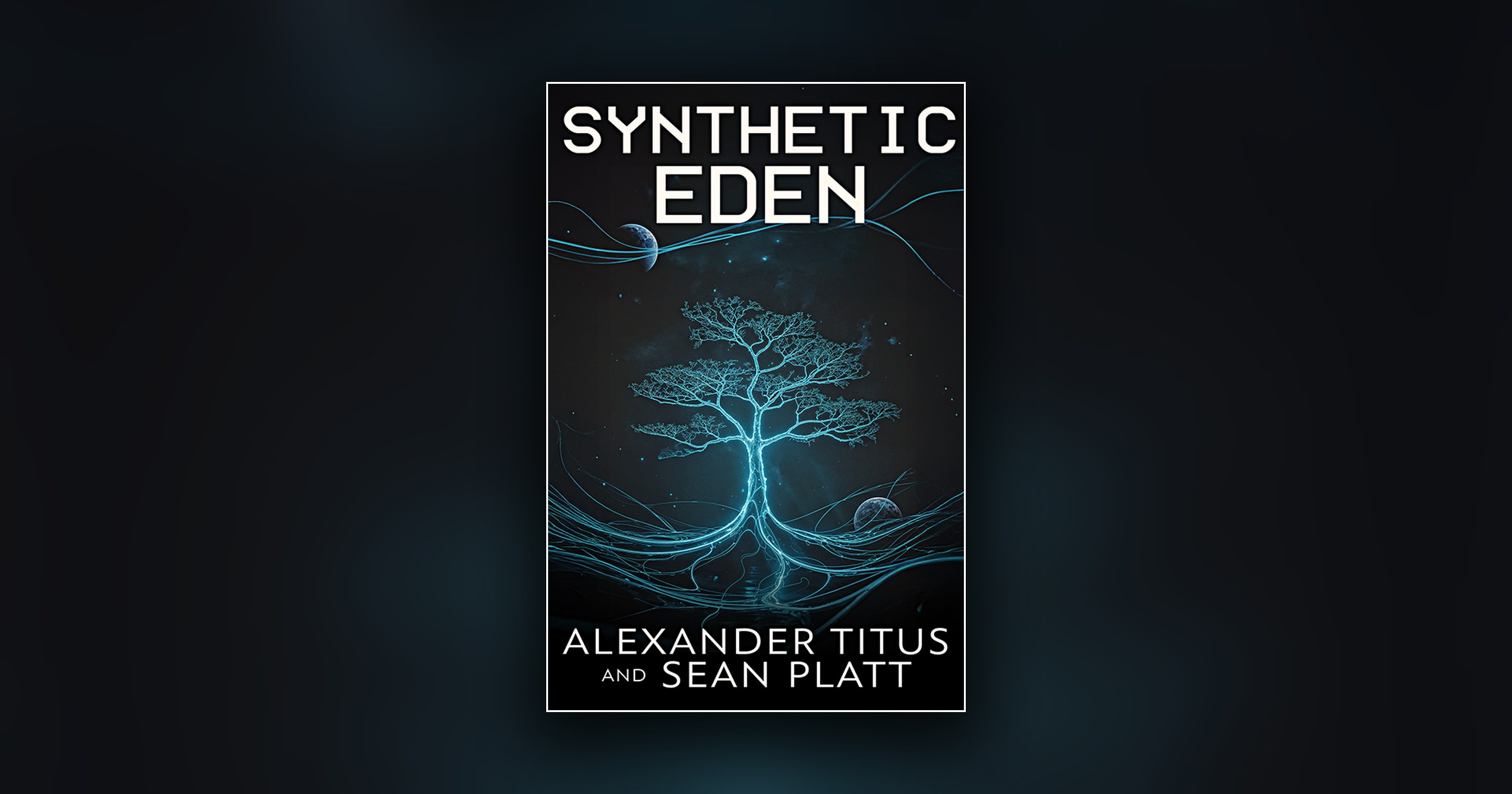
We called the book Synthetic Eden because the joke is in the title. Eden is the garden you are handed, already tuned to keep you breathing. Nobody in this story gets handed anything. They arrive somewhere that was never meant for them and slowly understand that the only way to stay is to become the kind of creature that could have belonged there in the first place.
Which is, if you pull the camera back far enough, close to the position we are actually in. We are not fleeing a dead Earth. But we are, for the first time, holding the tools to change the human being instead of the surroundings, and the reasons we will reach for them will be Samara’s reasons exactly. A sick child. A closing window. A world our biology no longer fits.
The book never tells you she is wrong.
It just refuses to let you feel finished about her being right.
Synthetic Eden is Book One of Echoes of Tomorrow, by Alexander Titus and Sean Platt.