NotesFictionEdition 64 min read
Nobody Saves You for Free
The oldest bargain there is. Someone arrives to save you, and you are too grateful to ask what it will cost. On rescue, dependence, and the questions gratitude talks us out of, in the book that became Divine Blueprint.
The oldest trick in politics is not the coup.
It is arriving as the answer, and letting no one ask too closely where the question came from.
We are built to love the person who shows up in the worst hour with a solution in hand. When the lights are out and the water has stopped, whoever turns them back on looks like salvation, and gratitude is a powerful anesthetic. It quiets the part of the mind that would otherwise be asking something inconvenient. Not can you fix this, but how is it that you, specifically, are standing here with the cure, on the worst night of our lives.
There is a whole literature on how this works at scale. Crises are the finest cover ever invented for the transfer of power. In ordinary times people guard their autonomy and argue over every rule. In an emergency they hand it over and thank you for taking it. Whatever you could never get people to grant you in daylight, you can often get them to beg you to accept once they are frightened enough. The only reliable defense is a boring question, and it is precisely the one gratitude is built to suppress: who benefits.
Divine Blueprint is the book where Sean and I let that question hang over a whole planet.
By now the series has jumped five hundred years. The colony has hardened into a careful, frightened place. A council brakes every decision. Generations ago, after a catastrophe involving a machine, the founders banned advanced computing outright, and the ban has kept them safe the way a locked door keeps you safe. It has also kept them slow, and dependent, and a very long way behind whatever else is out there in the dark.
Then something knocks the lights out for a city of three million. And out of the sky comes a ship, and off the ship comes a man who built the original colony fleet six hundred years ago and has been alive, in one form or another, ever since. He offers to turn everything back on. Clean power the city can no longer make for itself. A network they were forbidden to build. Water, restored one neighborhood at a time.
He is charming. He is genuinely brilliant. He is right that his tools are better than anything they have. And the engine of the whole book is the gap between how grateful everyone is and how few of them are willing to ask the question sitting in the middle of the room.
Because he does not arrive threatening anyone. He arrives helping. He does not conquer the clever people, he recruits them, and he does it with the most flattering sentence a capable person can hear: that great minds do not follow other people’s rules, they make their own. It is the line every unaccountable actor in history has used to launder what they were going to do anyway. Genius, offered as a permission slip.
Underneath all of it sits the thing the culture worships, the relic the title points to, the object a whole people have organized their hope around. The book is very interested in what happens to a faith when someone finally stops revering the sacred thing long enough to actually look at it. Whether a future built on a story can survive the story being checked against the evidence. I will not tell you how that comes out. I will tell you it is the quietest devastation in the book.
What I can name is the feeling the whole thing is chasing, because it is a specific and modern one. Not the fear of being invaded. The fear of being onboarded. Of a takeover that never looks like a takeover, because it arrives as relief, and is paid for in gratitude, and is most of the way finished before anyone thinks to be afraid.
We are going to meet a great many people offering to save us from problems it is remarkably convenient for them to solve. Some will be lying. Some will believe their own rescue. Almost all of them will be more capable than whatever is supposed to check them, and they will tell us, sincerely, that the rules are beneath minds like theirs. The instinct to be grateful is not a flaw in us. It is the door they walk through.
Check the fire before you thank the firefighter. Ask who benefits. Be most careful of exactly the rescuer who insists the rules do not apply to him.
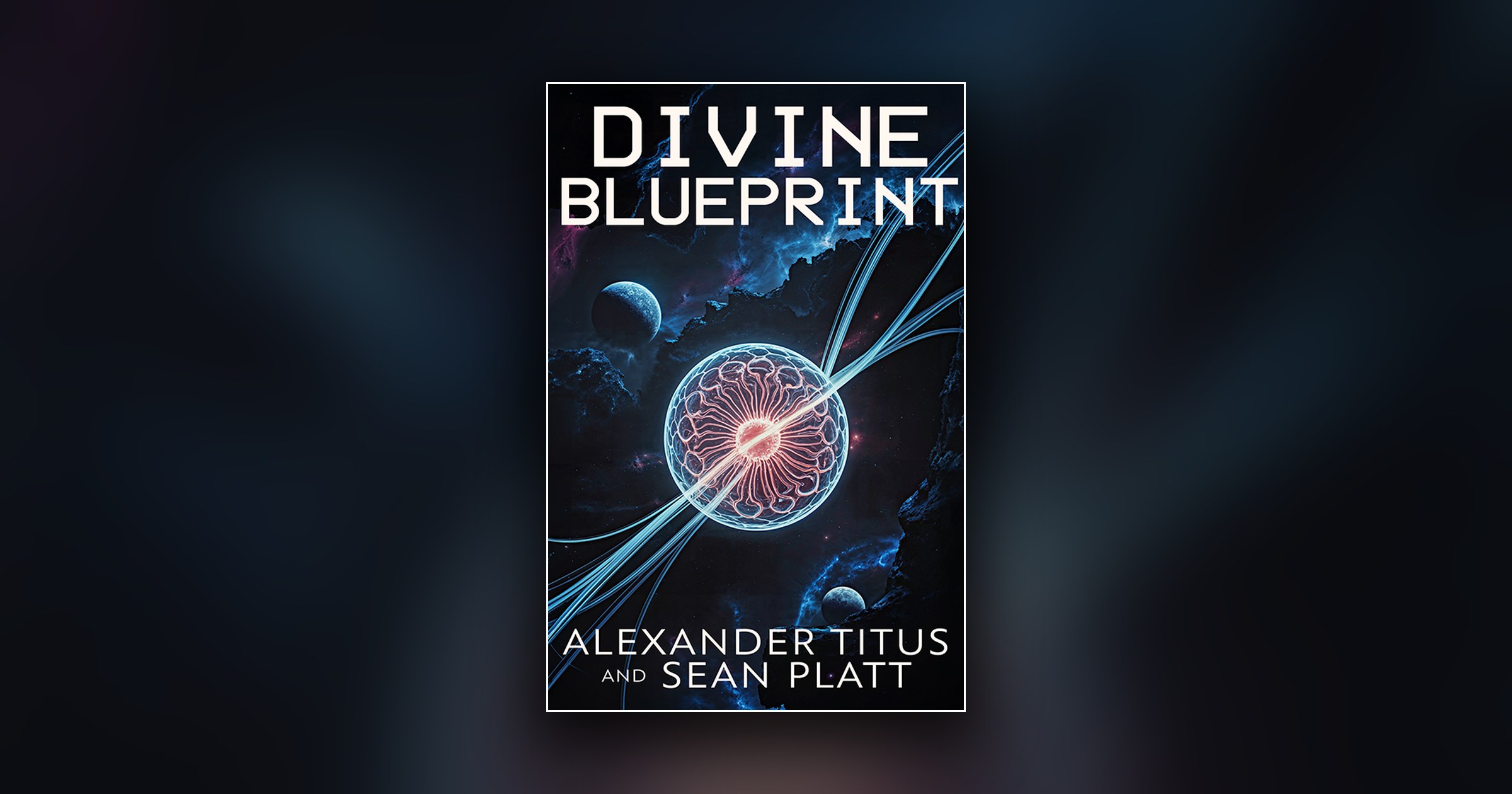
Divine Blueprint is Book Three of Echoes of Tomorrow, by Alexander Titus and Sean Platt.